

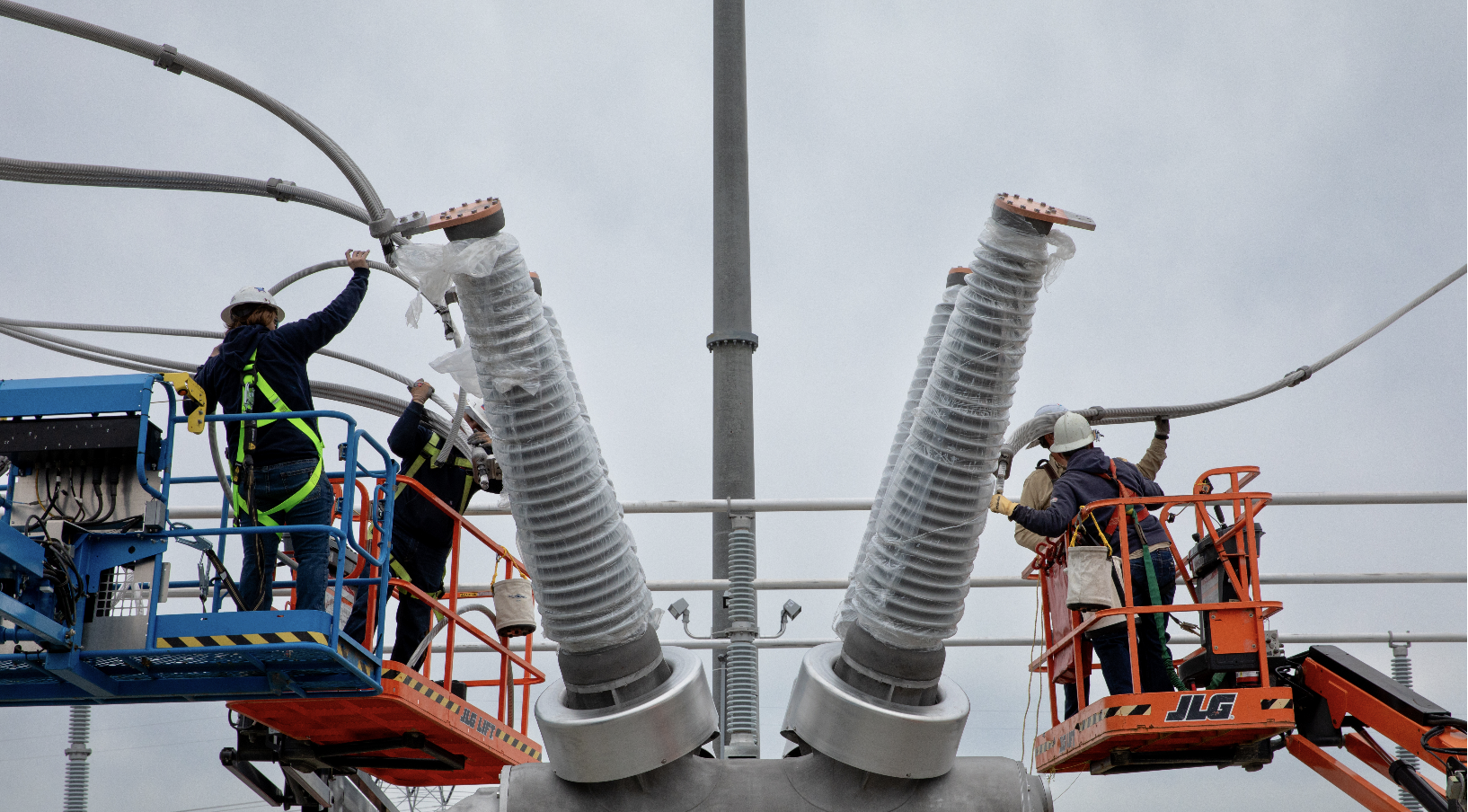
At 3,200 megawatts of power (3.2 gigawatts), OpenAI’s planned data center (Project Camellia) in Effingham County could eventually use enough electricity to power more than 2 million American homes or a major city. Impending data center development and ongoing industrial growth in the region has Coastal Georgia’s power grid undergoing its largest expansion since the 1970s, anchored by major transmission upgrades and a nearly 10 gigawatt statewide capacity expansion.
Capacity. The 10 gigawatt power generation expansion that was approved by the Georgia Public Service Commission (PSC) in December 2025, represents a 50% increase in overall capacity with about 80% of capacity dedicated to serving data centers and large load customers like the Hyundai Metaplant in Bryan County, the Port of Savannah, and surrounding industrial users.
Recent & Planned Upgrades. In mid-2026, Georgia Power brought the Big Ogeechee Substation online in west Chatham County, which doubles delivery capacity to the Savannah MSA (Chatham, Effingham, and Bryan counties). A new 500-kilovolt (kV) transmission line is planned to help power Effingham county’s industrial corridor. Georgia Power is also rebuilding a 20-mile transmission line in Jesup, upgrading lines in Savannah, and storm-hardening lines serving barrier islands like Tybee and St. Simons. Plant McIntosh in Effingham County currently generates over 1,000 megawatts (MW). Georgia Power is seeking environmental permits to expand the plant by up to two additional combined-cycle natural gas units causing backlash from community and environmental groups as Plant McIntosh was the state’s fourth largest carbon dioxide emitter in 2022.
While Georgia Power is the big behemoth in the state, there are also 38 Electric Membership Cooperatives (EMCs) throughout Georgia. EMCs are member-owned, not-for-profit utilities that partner with Oglethorpe Power and Georgia Transmission to bring power to rural and suburban communities across the state. At this time, no new upgrades are planned for the EMCs serving Savannah and Coastal Georgia.
Where Georgia’s Electricity Comes From. Coastal Georgia pulls power from the broader statewide transmission grid. The main sources of electricity in Georgia are natural gas (39%), nuclear (35%), coal (14%), and solar + other renewables (13%).
Georgia PSC. Following the November 3, 2026 election and effective January 1, 2027, Democrats will hold a majority on the Georgia Public Service Commission. The PSC regulates utility rates, power contracts, and generation planning.
The incoming Democratic majority campaigned heavily on residential affordability. Commissioners will decide how residential rates are structured once Georgia Power’s current rate freeze expires in 2028. The new PSC majority may give clean-energy advocates greater leverage to push for utility-scale solar paired with battery storage rather than additional fossil-fuel plants.
We’ll be following along as electricity infrastructure rushes to keep pace with growing demand across our region.
Sources & Further Reading:
Plant McIntosh (Savannah Morning News, Dec 19, 2025)
Plant McIntosh, Power Grid Expansion (Coastal Courier, August 20, 2026)
Georgia Analysis (US Energy Information Assoc, April 16, 2026)
PSC (Georgia Recorder, November 4, 2026)
Effective Load Carrying Capability (Inside Climate News, November 14, 2026)