

In a city that was once relatively affordable, rents and home prices in Savannah have spiked in recent years. According to the National Association of Home Builders, Savannah home prices increased 82% between Q1 2020 and Q4 2025. Rents increasing 40-50% over the same time period. Covid-19? Yes, and many other factors contribute—supply shortages; higher interest rates; restrictive zoning; wage stagnation; and the rising costs of building materials, construction labor, and insurance.
Meanwhile, a recent Georgia Tech study suggests Savannah needs 3,700 new housing units over the next 6 years to meet future population growth. That’s in addition to the current estimated 10,000 unit shortfall. Our local supply strains echo what other cities and communities are experiencing across the country so we’re looking at ways policymakers are attempting to help add supply and make the overall market more affordable.
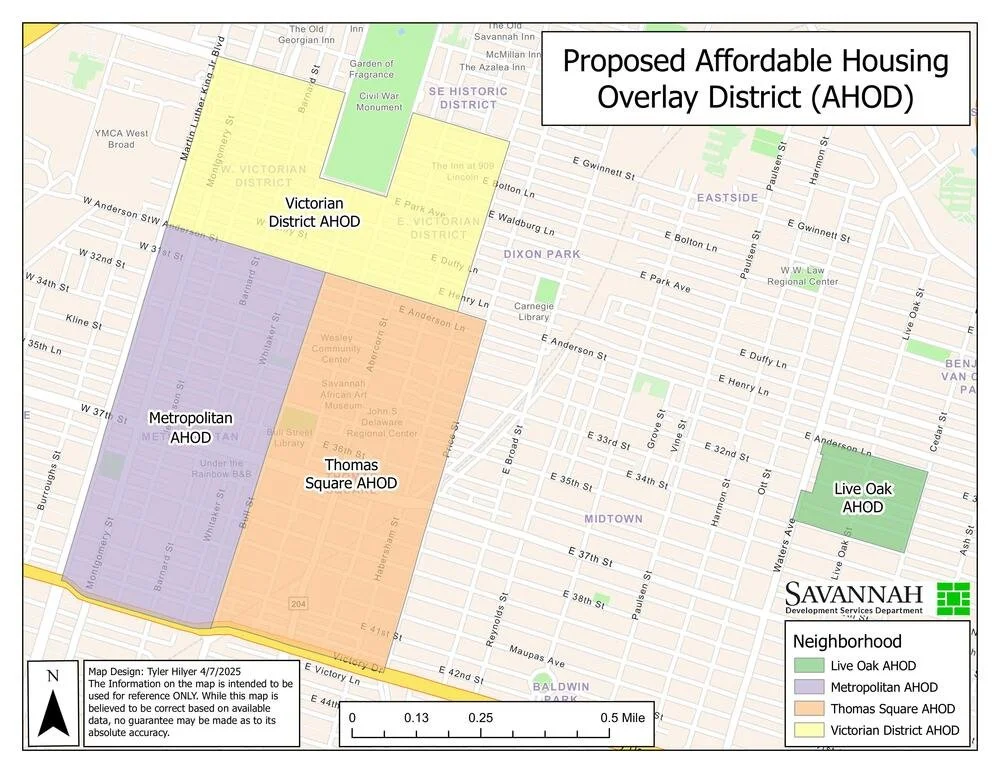
Savannah city government has spent a long time talking about supply and affordability. Recently, they have been doing a bit more than talking—passing measures to make ADUs (Accessory Dwelling Units) easier to build, and establishing an affordable housing overlay district to allow higher density building. Earlier this month, City Council participated in a12-stop bus tour of Savannah’s housing landscape. According to the Savannah Morning News, other policies under consideration include an expansion of affordable housing density bonuses, allowing multifamily housing in business-community districts, and streamlining permit processes.
At the state level, Georgia Senate Bill 33 contains limited restrictions on local property taxes and passed in the final hours of the latest legislative session that ended on April 2, 2026. Where the state government has the biggest impact on housing supply is through the allocation of Low Income Housing Tax Credits (LIHTC). The Georgia Department of Community Affairs (DCA) on behalf of the Georgia Housing and Finance Authority (GHFA), sets rules, prioritizes projects, and awards tax credits annually to developers through a competitive process based on a Qualified Allocation Plan (QAP). The QAP includes public input and requires final approval by the Governor.
The federal government authorizes the LIHTC program (roughly $10.5 billion annually) and distributes credits to state agencies based on population. The U.S. Department of Housing and Urban Development (HUD) designates which census tracts qualify for the LIHTC on an annual basis. To be eligible, a tract must have 50% or more of households with incomes below 60% of the Area Median Gross Income (AMGI) or have a poverty rate of 25% or more.
If the 21st Century ROAD to Housing Act gets through reconciliation and is signed into law, we’ll look at it in the future.
Our top votes:
Expand and strengthen the LIHTC program with more credits and an increase in the credit rate
Compliment LIHTC with increases to HOME funds, CDBG, other state and local gap financing options
Streamline the permitting and approval process… please!!!
Zoning changes with a special focus on density and getting rid of (or greatly lessening) parking requirements
We would love to hear your thoughts and top votes for policy solutions to address this massive issue. And, yes, we love to work with multi-family and mixed-use developers and investors.